
PDSA Posters
- CLICK HERE TO VIEW THEIR POSTER
- Prepared by Judy Jenkins
- Partnerships in Teaching and Learning – ABSTRACT: EKU’s Center for STEM Excellence offers student-facing academic support for all EKU students in STEM courses and programs. Center initiatives critically rely on partnership amongst students, student partners, instructors, and other campus resources. We draw on the seminal work by Alison Cook-Sather and coworkers, who articulated and demonstrated various models for partnerships with students in teaching and learning, where collaborative reciprocity can yield authentic inclusivity. We seek to emulate these practices such that student voices are understood and integrally meaningful in creating more equitable, inclusive learning environments. To realize these partnerships, we utilize the Learning Assistant model, where undergraduate STEM students partner with instructors to facilitate student engagement and sense-making, and to implement evidence-based instructional techniques. Importantly, Learning Assistants diversify the instructional team, allowing students opportunities to see themselves as leaders in STEM. In Academic Year 2022 – 2023, the first full year of the Center’s operations, Learning Assistants working in the Center facilitated nearly 14,000 interactions with EKU students in course-specific, for-credit learning activities. Here we describe our local implementations of the Learning Assistant model with a focus on the training and professional development needed to implement this model in meaningful ways.
- CLICK HERE TO VIEW THEIR POSTER
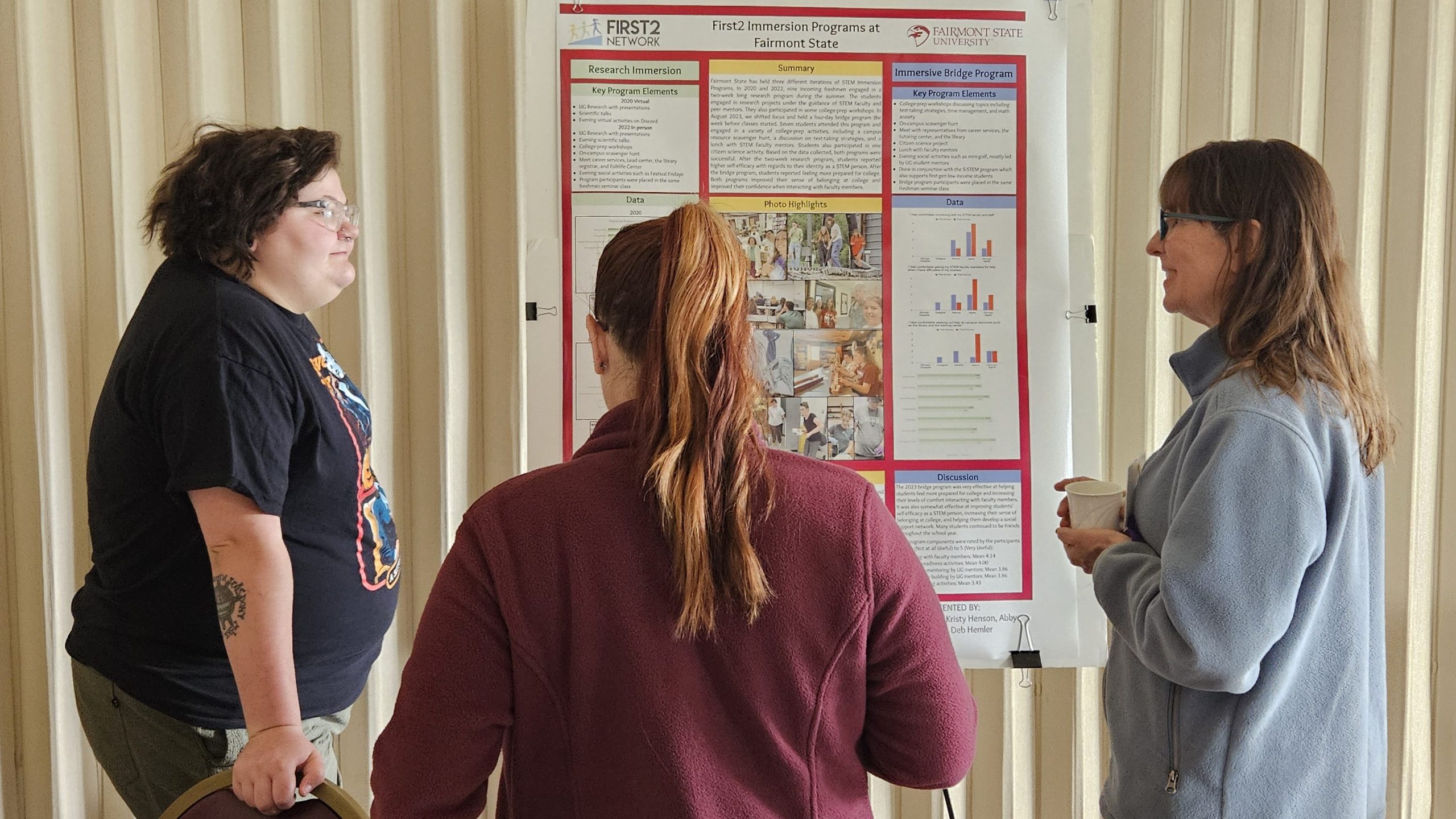
- Prepared by April Townsend, Abby Chapman, Kristy Henson, and Deb Hemler
- Fairmont State Immersion Programs – ABSTRACT: Fairmont State has held three different iterations of STEM Immersion Programs. In 2020 and 2022, nine incoming freshmen engaged in a two-week long research program during the summer. The students engaged in research projects under the guidance of STEM faculty and peer mentors. They also participated in some college-prep workshops. In August 2023, we shifted focus and held a four-day bridge program the week before classes started. Seven students attended this program and engaged in a variety of college-prep activities, including a campus resource scavenger hunt, a discussion on test-taking strategies, and a lunch with STEM faculty mentors. Students also participated in one citizen science activity. Based on the data collected, both programs were successful. After the two-week research program, students reported higher self-efficacy with regards to their identity as a STEM person. After the bridge program, students reported feeling more prepared for college. Both programs improved their sense of belonging at college and improved their confidence when interacting with faculty members. In August 2025, we plan to combine the strengths of both immersions and hold a longer bridge program before the semester begins that both prepares the students for college and allows them to engage in research projects.
- CLICK HERE TO VIEW THEIR POSTER
- ABSTRACT: The Plan-Do-Study-Act (PDSA) cycle was employed to organize and evaluate the second annual Pi Day Event at Blue Ridge Community and Technical College, aiming to celebrate Pi Day with faculty, students and the community through pies, circle-shaped treats, and math-related activities. The event took place on March 14th in the Tech Center campus, with a focus on engaging attendees in fun mathmatical games and fostering connections within the academic community. Faculty members spearheaded the organization, coordinating refreshments, activities, and outreach efforts. Key learnings emphasized the importance of task delegation, effective communication, and comprehensive advertising strategies. Recommendations for adaptation include explicit task assignments, faculty outreach during the event, and intensified advertising efforts to enhance future events. The PDSA approach proved instrumental in optimizing event execution and guiding iterative improvements for future Pi Day celebrations. Co-curricular assessment of student learning will be integrated into future Pi Day events.
- CLICK HERE TO VIEW THEIR POSTER
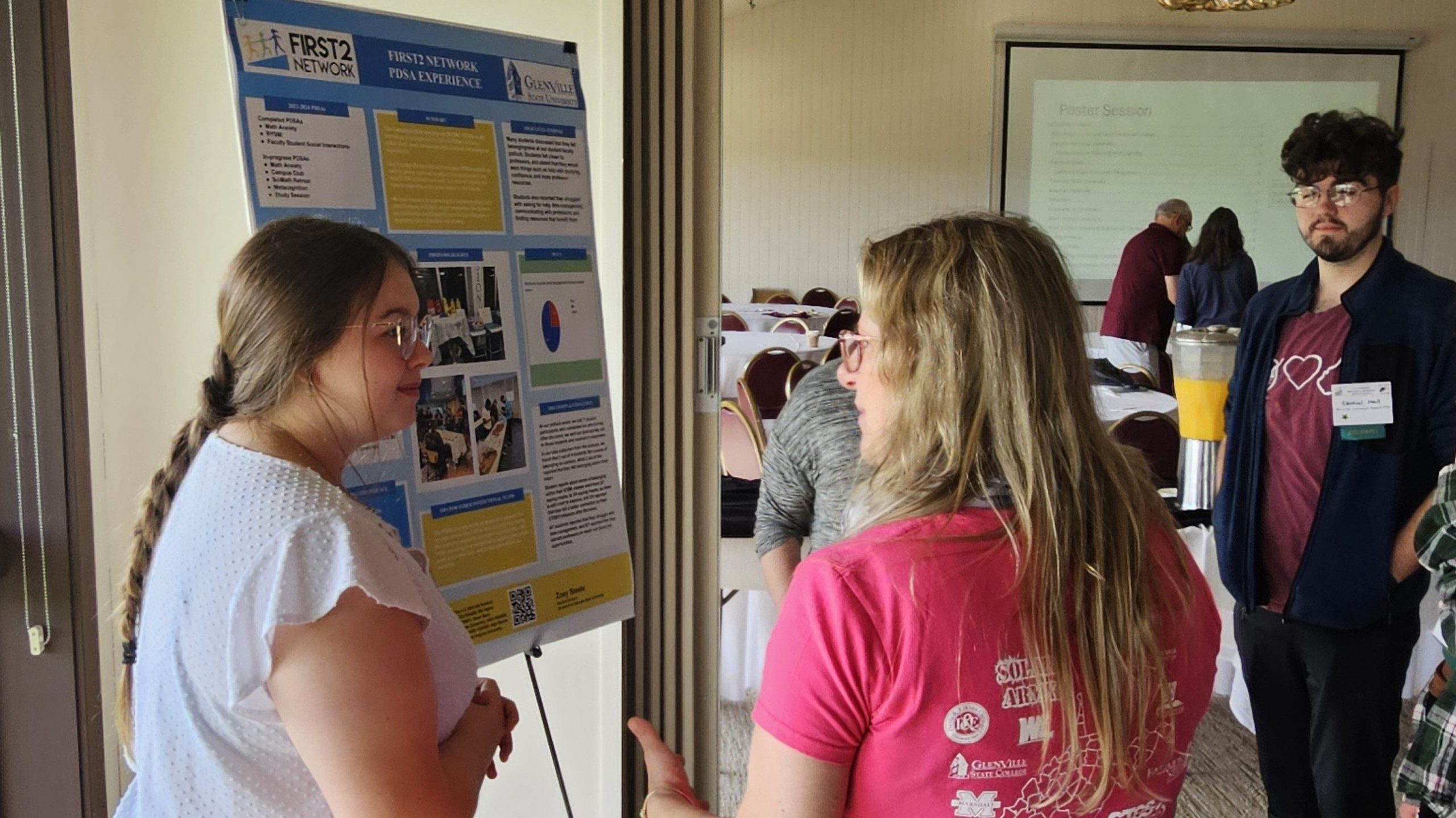
- Prepared by Brooke Fincham, Sara Sawyer, Zoey Steele, and Addison Aguiniga, and Chelsea Stickelman
- ABSTRACT: Throughout the 23-24 school year, our GSU institutional team conducted a total of 7 PDSAs. Two of these were spearheaded by student directors Zoey Steele and Addison Aguiniga. This poster focuses on their Faculty Student Social Interactions PDSA. For this PDSA, we hosted a potluck and invited all GSU STEM faculty and GSU students with a declared major or minor in STEM (or STEM adjacent field). Students were given pre- and post-surveys, the results of which are presented here.
- POSTER (link pending)
- Prepared by Rosalynn Quiñones, Callia Yang, and Zane Lewis
- ABSTRACT: Campus clubs are an important part of every First2 scholar’s experience, especially at Marshall University (MU). MU Campus Club leaders such as First2 co-chairs and student directors have done multiple students led PDSAs throughout the 2023-2024 academic year. These PDSAs included a Fall and a Spring Campus Club, Donuts with Deans, Faculty Networking Dinner with the Deans, Peer Mentoring Across Institutions Program, and Semester Research Immersion. Through the Semester Research Immersion, many of our students have presented their research posters at events across the state such as the Undergraduate Research Day at the Capitol and Marshall University’s Research and Creativity Symposium. Marshall’s First2 scholars have also been active members of the Huntington community by volunteering at the American Chemistry Society Children’s Fair at Heritage Farm and the High School Science Olympiad. Marshall’s institutional team has planned PDSAs for the next academic year and the team has learned a lot about the PDSA process with the help of PDSA coaching First2 provides to all First2 members. Donuts with the Deans was this year’s most successful PDSA, as it had a lot of participants and higher-quality data.
- CLICK HERE TO VIEW THEIR POSTER
- Prepared by Haley Albright, Robert Monahan, Robert Warburton, Andrew Belcher, Tajmarie Rowe, Jacob Doyle, Anika Wirt, Jacquelyn Cole, and Sytil Murphy
- ABSTACT: Shepherd University joined First2 during the Spring 2024 semester. We met with the First2 Team in mid-March over our Spring Break for our official onboarding and held our Institutional Orientation Session to recruit students and faculty into the program the week after which was attended by 20-30 students and a handful of faculty. Our student club was officially recognized on the same day. Given our late start, some great benefits have come out of being part of First2 – the student club hosted a final exams preparedness seminar attended by 25-30 students and hosted final exam study sessions attended by 25-30 students on the first day and 35-40 students on the second. We are also developing a Shepherd Student Success Center – a place where our students can go to work between classes individually or in groups or for informal meetings with faculty.
- CLICK HERE TO VIEW THEIR POSTER
- Prepared by Hailey Cox, Emily Hissom, Jennifer Hoffman, Karen Kail, and Stephen Mech
- ABSTRACT: The University of Charleston would like to thank all the great coaches for helping us refine our PDSAs to be the best that they could be this past year. We undertook many PDSAs and have learned quite a lot through them. Our most successful were the Impromptu Lectures, facilitated by students and faculty together. As a team-building exercise to improve student sense-of-belonging and comfort in talking with faculty/administrators, students hosted an impromptu/improv lecture activity with faculty/administrators from the Department of Natural Sciences and from the Department of Computer Science, Data Analytics, and Mathematics. Students used information/slides from various STEM class lectures, put them together into a creative PowerPoint, and asked faculty to give a 5-minute impromptu lecture on slides that were not in their own subject area. This activity was designed to get faculty out of their comfort zones in front of students, to allow students to see a humorous side of faculty, and to allow faculty to gain a better understanding of the student experience of dealing with various new material which they’re held accountable for learning and knowing. The immediate purpose of this idea was to make students feel more comfortable speaking with faculty members and administrators by having them interact in a casual setting. Also, the goal was to use this social event as a launching point for future conversations between students, administrators, and faculty that lead to systemic change.
- CLICK HERE TO VIEW THEIR POSTER
- Prepared by Rachel King, Keyzar Dominguez and Lori Ogden
- ABSTRACT: For WVU, one standard PDSA in Spring 2024 was our STEM Professor Panel. Six seasoned instructors of first- and second-year biology, chemistry, mathematics or physics classes served as panelists to answer student questions. Our First2 Scholars fashioned a series of preparatory questions which were answered by panelists during the first half of the event. The panel took questions from student attendees during the second half. At least three additional instructors offered extra credit from their students if they attended the panel event. We have over 100 students attend and, after attending, the average student displayed a stronger sense of belonging in STEM. Panelists touched on topics related to imposter syndrome, failure, and rebounding from low grades. We expect to repeat this successful PDSA in Fall 2024.
- CLICK HERE TO VIEW THEIR POSTER
- Prepared by Aida Jimenez Esquilin and Kimberlyn Gray
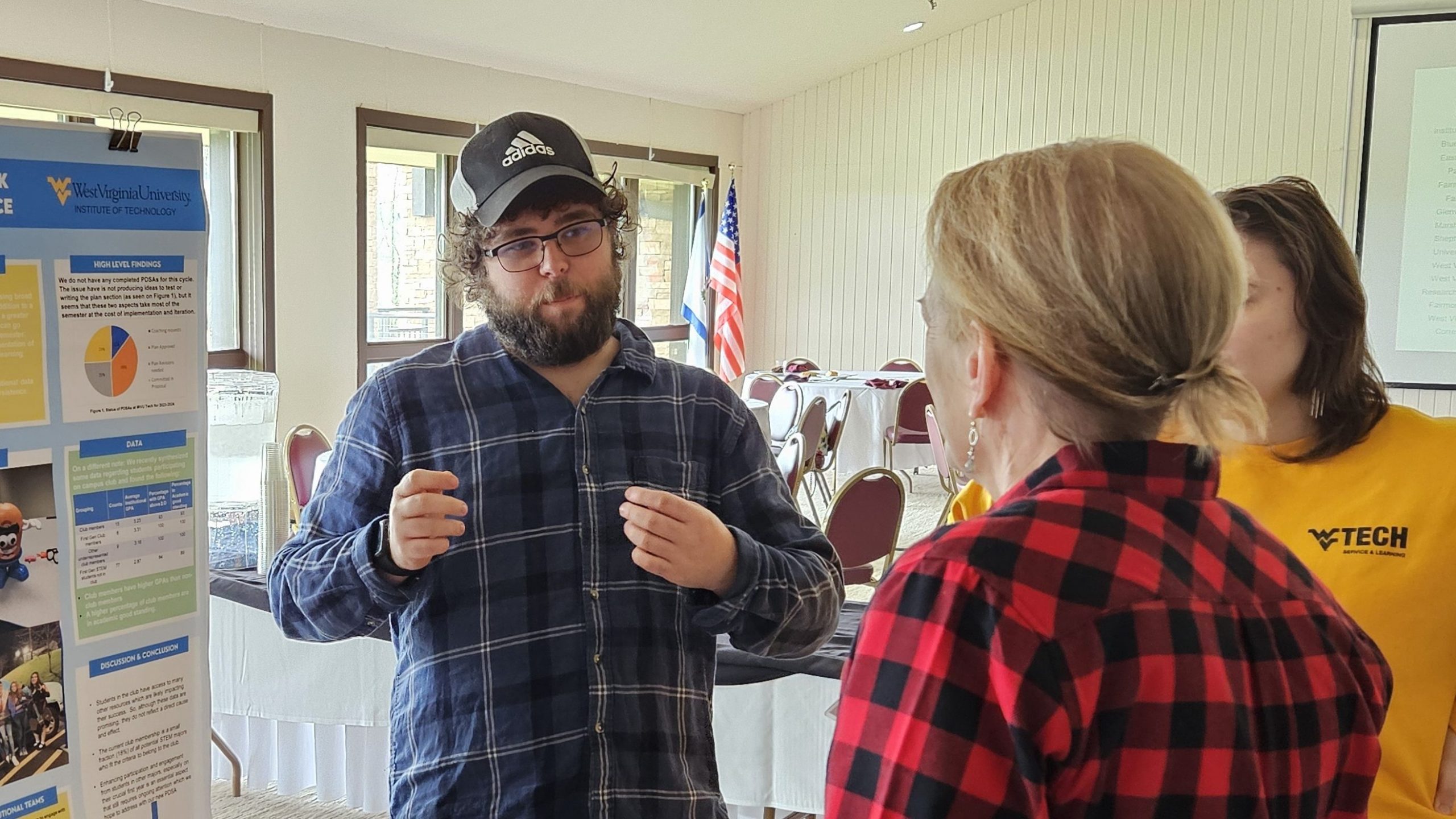
- ABSTRACT: This year we recognized the difficulty of addressing broad change ideas within a single semester. PDSAs which were started included Campus Club, Improve Participation in Campus Club, and WVUIT Campus Resources, although we were not able to move through the Study and Act portions of the PDSA cycle yet. So, in addition to a few broad-reaching PDSAs, we will incorporate a greater number of focused, short-duration PDSAs that can go through multiple iterations in a single year or semester. This strategy aims to facilitate effective implementation of changes while also allowing for flexibility and learning from multiple PDSA cycles. In addition, we will share a first glimpse at promising institutional data regarding student engagement in club and success and persistence.
Additional Posters
- POSTER (link pending)
- Joshua George and Kristy Henson, College of Science and Technology, Fairmont State University, Fairmont WV, 26554. Exploring mathematic struggles among STEM students at Fairmont State University
- ABSTRACT: Mathematics serves as the cornerstone of every STEM major, and proficiency in this subject is paramount for achieving academic success. In West Virginia, students face an additional hurdle, poverty, with households in the state ranking among the lowest earners in the nation. This can have significant implications for the funding and resources available to the West Virginia School System. Recognizing the interplay between socioeconomic factors and academic performance is crucial for devising targeted interventions and providing necessary support. We administered a survey in 50 STEM courses at Fairmont State University (n=447) and collected data from the LEAD Center on tutoring. Preliminary results show that math made up 50% and chemistry 37% of requested tutoring subjects in STEM and 69.7% receiving tutoring were in their first two years. Survey demographics are the following: gender identity: 212 male, 212 female, and 4 non-binary; economic status: 82% middle class, 13% working class, and 4% on assistance; 29.5% are first-generation; 62% are within their first two years of study. The most common math completed in high school was algebra (24.8%), trigonometry (34%), and calculus (24.4%). Through data analysis and working with students directly, our goal is to discover why students struggle with math and how to better prepare future generations.
- CLICK HERE TO VIEW THIS POSTER
- ABSTRACT: The Dark Triad refers to the psychological concept of “dark” personalities, the personalities being narcissism, psychopathy, and Machiavellianism. Intrusive thoughts are a common aspect of anxiety and stress-related disorders but can occur without an individual having such a disorder. Typically, intrusive thoughts are darker and are often violent or vulgar. This study had a main focus on psychopathic and Machiavellian personalities and examined if such personalities were strong predictors of the frequency of intrusive thoughts in an individual. Participants (N=53) were asked to complete two surveys. The first survey was the Dirty Dozen Survey (Jonason & Webster, 2010), which is a measure of where an individual falls on the Dark Triad. This survey measures each aspect of the Dark Triad to average an overall “dark” score. The second survey, the Obsessional Instrusions Inventory (Purdon & Clark, 1993) is a series of fifty-two questions summed and averaged to find the frequency that individuals experience intrusive thoughts. Main analysis showed that there was a significant correlation between greater psychopathy and higher frequencies of instrusive thoughts, r(51)=.335, p<.05. Post-hoc analyses found that great Machiavellianism was associated with more intrusive thoughts, r(51)=.560, p<.001. Narcissism was unrelated to intrusive thought frequencies, r(51)=.152, n.s.